As is common practice with almost all professional websites this site uses cookies, which are tiny files that are downloaded to your computer, to improve your experience. This page describes what information they gather, how we use it and why we sometimes need to store these cookies. We will also share how you can prevent these cookies from being stored however this may downgrade or 'break' certain elements of the sites functionality.
How We Use Cookies
We use cookies for a variety of reasons detailed below. Unfortunately in most cases there are no industry standard options for disabling cookies without completely disabling the functionality and features they add to this site. It is recommended that you leave on all cookies if you are not sure whether you need them or not in case they are used to provide a service that you use.
Disabling Cookies
You can prevent the setting of cookies by adjusting the settings on your browser (see your browser Help for how to do this). Be aware that disabling cookies will affect the functionality of this and many other websites that you visit. Disabling cookies will usually result in also disabling certain functionality and features of the this site. Therefore it is recommended that you do not disable cookies. This Cookies Policy was created with the help of the Cookies Policy Generator from CookiePolicyGenerator.com.
The Cookies We Set
Forms related cookies
When you submit data to through a form such as those found on contact pages or comment forms cookies may be set to remember your user details for future correspondence.
Third Party Cookies
In some special cases we also use cookies provided by trusted third parties. The following section details which third party cookies you might encounter through this site.
This site uses Google Analytics which is one of the most widespread and trusted analytics solution on the web for helping us to understand how you use the site and ways that we can improve your experience. These cookies may track things such as how long you spend on the site and the pages that you visit so we can continue to produce engaging content.
For more information on Google Analytics cookies, see the official Google Analytics page.
More Information
Hopefully that has clarified things for you and as was previously mentioned if there is something that you aren't sure whether you need or not it's usually safer to leave cookies enabled in case it does interact with one of the features you use on our site.
This acknowledgement applies to the donation of blood, blood components, and biospecimens through sample collection, venipuncture by a phlebotomist or by Apheresis (automation) method.
I agree that the Coastal Bend Blood Center may draw my blood, biospecimen, or blood components via sample collection, whole blood or automated (apheresis) collection, and use my personal information, for testing and use for appropriate purposes determined by the Coastal Bend Blood Center, including but not limited to transfusion, education, research, development of therapy products including commercialization of donated products, quality control, further manufacturing, and development of methods for processing blood. For the safety of the blood supply, I confirm to the following:
I have read and understand the educational material provided to me regarding relevant transfusion-transmitted infections.
I agree not to donate blood or blood components for transfusion or further processing if I am at risk of spreading relevant transfusion-transmitted infections (e.g., Hepatitis B, Hepatitis C, HIV, etc.).
I understand that my blood will be tested by screening and/or research test(s) for specified relevant transfusion-transmitted infections. I understand that there are circumstances in which this testing may not be able to be performed.
If my donation is determined to be unsuitable based on eligibility and/or testing criteria, I will be ineligible for allogeneic donation. My donor record will identify me as ineligible to donate and maintain indicating the reason for the deferral and deferral time period.
I understand that all test results are confidential and also understand that I will be notified of any significant results (positive or not clearly negative), along with the deferral period.
I understand and consent to the Coastal Bend Blood Center’s use and disclosure of information provided herein as well as the results (positive) of any tests performed, as stated under federal and state laws (Texas Health Department).
I understand that the donation of blood and blood components is not without risks, including but not limited to pallor, nausea, vomiting, light-headedness, dizziness, fainting, feeling of warmth, fever, headache, hypotension, fluctuations in blood pressure, excessive tiredness, bruising (hematoma), arterial puncture, bleeding after leaving the donation site, nerve injury, seizure, temporary loss of bladder control, anemia, blood loss, hyperventilation, hypovolemia, hemolysis (cell damage), infection, blood clot formation (thrombosis), vein inflammation (phlebitis), air embolism, convulsion, abdominal cramps, urticaria/allergic reaction, flushing, skin redness, itching, hives, difficulty in breathing, chest pain or bronchospasm, and iron depletion, which may be life threatening.
The donation process has been explained to me.
I have had the opportunity to ask questions about the donation processand had them answered.
I understand that my participation is voluntary.
I have the opportunity to refuse participation and withdraw from the donation procedure at any time.
The medical history I have furnished is true to the best of my knowledge. I agree to abide by the post donation instructions given to me.
By agreeing to donate, I agree to the use of my blood samples in research and/or for the other purposes described in this form and acknowledge that my blood samples may be stored indefinitely. I understand that my samples may be used for genetic research, including whole genome sequencing.
I acknowledge that I will not receive financial or other benefits from any such research or other permitted use of my blood or personal information. It is possible that commercial companies and researchers may benefit financially from the use of my blood samples.
I understand that research is an important way to try to understand human disease and my blood donation may be used, in whole or in part, at present, or stored for future use indefinitely in research projects. Research uses for my donation may be experimental. Future research uses are not fully defined, and I consent to unspecified research.
I understand I will not be informed of the details of any specific research studies that might be conducted, including the purpose of the research, and that I might have chosen not to consent to some of those specific research studies.
I understand the results of any research will not be disclosed to me.
Apheresis Donation
If donating Apheresis, in addition to the above acknowledgments, I also understand that following about this donation method:
Involves removing my blood, processing it in a sterile, disposable tubing set, collecting the needed components and returning the remaining blood to me. I understand that the procedure may require 30 minutes to 2.5 hours.
Will require me to receive an anticoagulant which prevents my blood from clotting during the course of the procedure, and, in some cases, saline will be added to the blood being returned to me.
A possible effect of the anticoagulant may cause reduced calcium in the blood. I may be offered antacids and/or calcium chews as calcium replacements.Calcium deficiencies (hypocalcemia)may cause severe muscle spasms, seizures, chest pain or pressure on the chest, and cardiac arrest.
Adverse reactions may include feelings of anxiety, chills, muscle cramps, muscle discomfort, muscle twitching or spasms, numbness, tingling sensation around the mouth and face, fever, headache, unpleasant taste sensations, convulsions due to changes in blood volume, chest pain and pressure. Serious reactions may include heart rhythm disturbances, difficulty breathing, seizures, vein inflammation, fluid overload, air embolism, hemorrhage, and excess clotting. These events may vary in severity from mild to life-threatening.
It has been explained to me that after donating platelets, my platelet count will temporarily decrease. I understand that my platelet count should return to normal within a few days after donation. The long-term effects of repeated platelet count are unknown.
I understand that if it is not possible to return my unused blood components to me or if significant changes in my hematocrit/hemoglobin levels occur, I may be ineligible to donate for a longer period of time.
I understand that Apheresis donors must meet the requirements for whole blood donation as they relate to automated donations.
I am aware of and accept the possibility of the medical risks described above.
Document ID #3003.005 Revision: 2
RECONOCIMIENTO DEL DONATE
El presente consentimiento reconocimiento se aplica a la donación de sangre, componentes sanguíneos y muestras biológicas mediante la obtención de muestras, venopunción realizada por un flebotomista o el método de aféresis (automatizado).
Autorizo al Coastal Bend Blood Center a extraer mi sangre, muestras biológicas o componentes sanguíneos ya sea mediante la toma de muestras, la extracción de sangre total o procedimientos automatizados (aféresis) y a utilizar mi información personal para realizar análisis y fines adecuados determinados por el propio Coastal Bend Blood Center. Dichos fines incluyen, entre otros: transfusión, educación, investigación, desarrollo de productos terapéuticos (incluida la comercialización de los productos donados), control de calidad, procesos de fabricación posteriores y desarrollo de métodos para el procesamiento de la sangre. Para garantizar la seguridad del suministro de sangre, confirmo lo siguiente:
He leído y comprendo el material educativo que se me ha proporcionado sobre las infecciones relevantes transmitidas por transfusión.
Me comprometo a no donar sangre ni componentes sanguíneos para transfusión o procesamiento posterior si corro el riesgo de transmitir infecciones relevantes por vía transfusión (p. ej., Hepatitis B, Hepatitis C, VIH, etc.).
Entiendo que mi sangre será sometida a pruebas de cribado y/o de investigación para detectar infecciones específicas y relevantes transmisibles por transfusión. Entiendo que existen circunstancias en las que es posible que no se puedan realizar dichas pruebas.
Si se determina que mi donación no es apta según los criterios de elegibilidad y/o de pruebas, no seré elegible para la donación alogénica. Mi registro de donante me identificará como no apto para donar y conservará la información sobre el motivo del aplazamiento y el período de duración del mismo.
Entiendo que todos los resultados de las pruebas son confidenciales y también comprendo que se me notificará cualquier resultado significativo (positivo o no claramente negativo), junto con el periodo de aplazamiento.
Comprendo y autorizo al Coastal Bend Blood Center a utilizar y divulgar la información aquí proporcionada, así como los resultados (positivos) de cualquier prueba realizada, de conformidad con las leyes federales y estatales (Departamento de Salud de Texas).
Comprendo que la donación de sangre y componentes sanguíneos no está exenta de riesgos, entre los que se incluyen, a título enunciativo pero no limitativo: palidez, náuseas, vómitos, sensación de mareo o aturdimiento, desmayo, sensación de calor, fiebre, dolor de cabeza, hipotensión, fluctuaciones de la presión arterial, cansancio excesivo, hematomas (moretones), punción arterial, sangrado tras abandonar el lugar de la donación, lesión nerviosa, convulsiones, pérdida temporal del control de la vejiga, anemia, pérdida de sangre, hiperventilación, hipovolemia, hemólisis (daño celular), infección, formación de coágulos sanguíneos (trombosis), inflamación de las venas (flebitis), embolia gaseosa, calambres abdominales, urticaria o reacción alérgica, rubor, enrojecimiento de la piel, prurito (picazón), dificultad para respirar, dolor torácico o broncoespasmo, y agotamiento de las reservas de hierro, situaciones que pueden poner en peligro la vida.
Se me ha explicado el proceso de donación.
He tenido la oportunidad de hacer preguntas sobre el proceso de donación y de recibir respuesta a ellas.
Entiendo que mi participación es voluntaria.
Tengo la oportunidad de rechazar la participación y retirarme del procedimiento de donación en cualquier momento.
El historial médico que he proporcionado es veraz, según mi leal saber y entender. Me comprometo a seguir las instrucciones posteriores a la donación que se me han facilitado.
Al aceptar donar, consiento el uso de mis muestras de sangre en investigaciones y/o para los demás fines descritos en este formulario, y reconozco que dichas muestras pueden almacenarse indefinidamente. Entiendo que mis muestras pueden utilizarse para investigaciones genéticas, incluida la secuenciación del genoma completo.
Reconozco que no recibiré beneficios económicos ni de otro tipo derivados de dicha investigación o de cualquier otro uso permitido de mi sangre o información personal. Es posible que empresas comerciales e investigadores obtengan beneficios económicos del uso de mis muestras de sangre.
Comprendo que la investigación constituye una vía importante para comprender las enfermedades humanas y que mi donación de sangre puede utilizarse —total o parcialmente, ya sea de forma inmediata o tras su almacenamiento para uso futuro indefinido— en proyectos de investigación. Los fines de investigación para los que se utilice mi donación podrán ser de carácter experimental. Los usos en investigaciones futuras no están totalmente definidos, por lo que doy mi consentimiento para investigaciones no especificadas.
Entiendo que no se me informará sobre los detalles de ningún estudio de investigación específico que pudiera llevarse a cabo, incluido el propósito de la investigación, y que podría haber optado por no dar mi consentimiento para algunos de esos estudios de investigación específicos.
Entiendo que los resultados de cualquier investigación no me serán comunicados.
Donación por Aféresis
Si dono mediante aféresis, además de las declaraciones anteriores, también comprendo lo siguiente sobre este método de donación:
Implica extraer mi sangre, procesarla mediante un sistema de tubos estériles desechables, recolectar los componentes necesarios y devolverme la sangre restante. Entiendo que el procedimiento puede requerir entre 30 minutos y 2 horas y media.
Requerirá que reciba un anticoagulante que impida la coagulación de mi sangre durante el procedimiento y, en algunos casos, se añadirá solución salina a la sangre que se me devuelve.
Un posible efecto del anticoagulante es la disminución de los niveles de calcio en la sangre. Es posible que me ofrezcan antiácidos y/o comprimidos masticables de calcio para reponer el calcio. La deficiencia de calcio (hipocalcemia) puede provocar espasmos musculares graves, convulsiones, dolor o presión en el pecho y paro cardíaco.
Las reacciones adversas pueden incluir sensación de ansiedad, escalofríos, calambres musculares, molestias musculares, espasmos o sacudidas musculares, entumecimiento, sensación de hormigueo alrededor de la boca y la cara, fiebre, dolor de cabeza, alteraciones del gusto, convulsiones debidas a cambios en el volumen sanguíneo, así como dolor y opresión en el pecho. Las reacciones graves pueden incluir alteraciones del ritmo cardíaco, dificultad para respirar, convulsiones, inflamación de las venas, sobrecarga de líquidos, embolia gaseosa, hemorragia y coagulación excesiva. La gravedad de estos episodios puede variar desde leve hasta poner en peligro la vida.
Se me ha explicado que, tras donar plaquetas, mi recuento de plaquetas disminuirá temporalmente. Entiendo que mi recuento de plaquetas debería volver a la normalidad unos días después de la donación. Se desconocen los efectos a largo plazo de las donaciones repetidas de plaquetas.
Entiendo que, si no es posible devolverme los componentes sanguíneos no utilizados o si se producen cambios significativos en mis niveles de hematocrito o hemoglobina, es posible que no reúna los requisitos para donar durante un periodo de tiempo más prolongado.
Entiendo que los donantes de aféresis deben cumplir con los requisitos para la donación de sangre total en lo que respecta a las donaciones automatizadas.
Soy consciente de la posibilidad de los riesgos médicos descritos anteriormente y la acepto.
Document ID #3003.006 Revision: 2
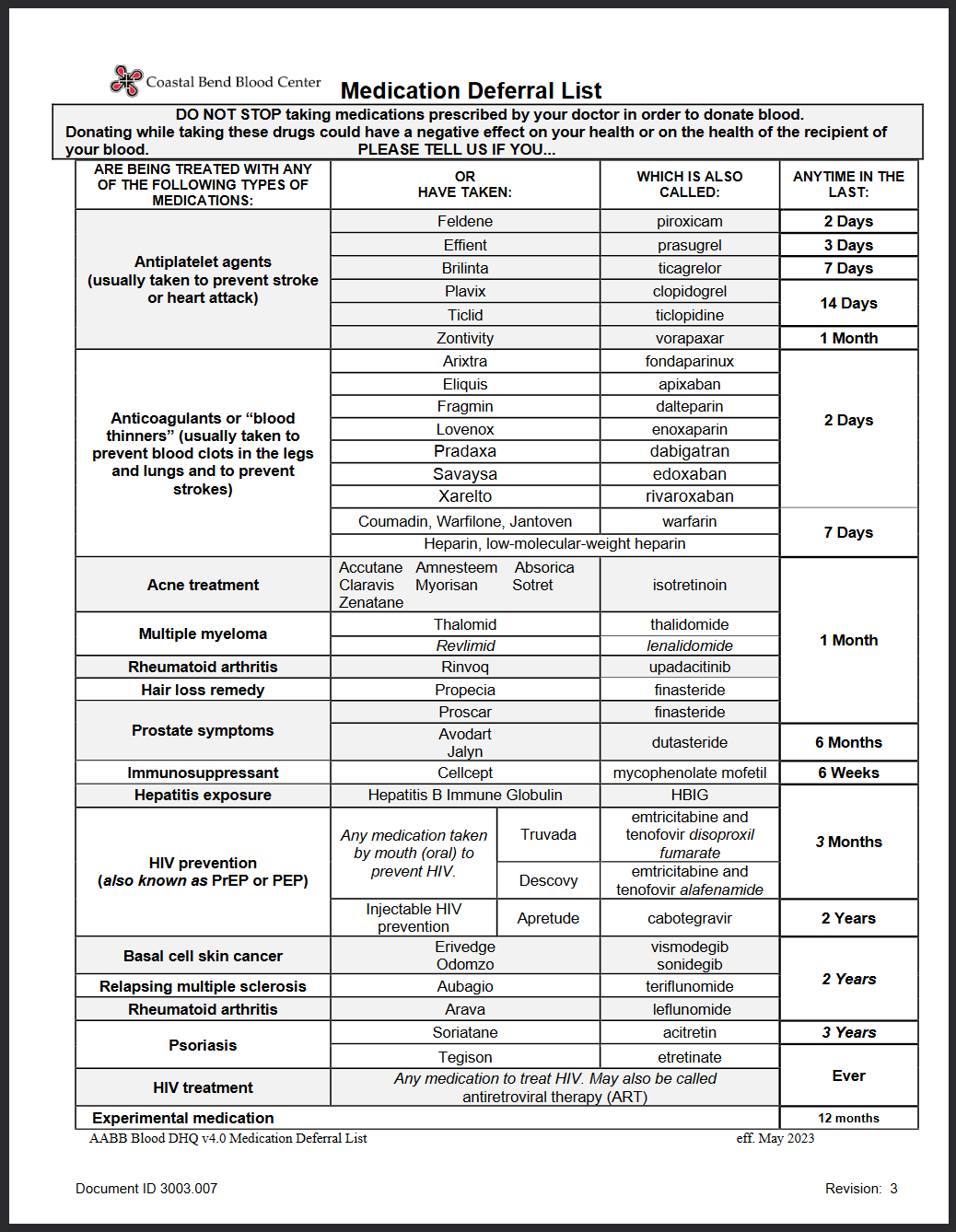
Medication Deferral List
DO NOT STOP taking medications prescribed by your doctor in order to donate
blood.
Some medications may affect donor eligibility for the following reasons:
Anti-platelet agents affect platelet function, so people taking these drugs should not donate platelets for the
indicated time. You may still be able to donate whole blood or red blood cells by apheresis.
Anticoagulants or “blood thinners” are used to treat or prevent blood clots in the legs, lungs, or other parts of the
body, and to prevent strokes. These medications affect the blood’s ability to clot, which might cause excessive
bruising or bleeding when you donate. You may still be able to donate whole blood or red cells by apheresis.
Isotretinoin, finasteride, dutasteride acitretin and etretinate can cause birth defects. Your donated blood could
contain high enough levels to damage the unborn baby if transfused to a pregnant woman.
Thalomid (thalomide), Revlimid (lenalidomide), Erivedge (Vismodegib), Odomzo (sonidegib), Aubagio (teriflunomide), Rinvoq (upadacitinib) may cause birth defects or the death of an unborn baby if transfused to a
pregnant woman.
Cellcept (mycophenolate mofetil) and Arava (leflunomide) are immunosuppressants which may cause birth
defects or the death of an unborn baby if transfused to a pregnant woman.
PrEP or pre-exposure prophylaxis involves taking a specific combination of oral medicines (i.e., short-acting
antiviral PrEP) or injections (i.e., long-acting antiviral PrEP) as a prevention method for people who are HIV negative
and at high risk of HIV infection. FDA has determined that the available data demonstrate that the use of PrEP or
PEP may delay the detection of HIV by currently licensed screening tests for blood donations, potentially resulting
in false negative results in infected individuals. Although “Undetectable = Untransmittable” for sexual transmission,
this does not apply to transfusion transmission.
PEP or post-exposure prophylaxis is a short-term treatment started as soon as possible after a high-risk exposure
to HIV to reduce the risk of infection. FDA has determined that the available data demonstrate that the use of PrEP
or PEP may delay the detection of HIV by currently licensed screening tests for blood donations, potentially resulting
in false negative results in infected individuals. Although “Undetectable = Untransmittable” for sexual transmission,
this does not apply to transfusion transmission.
ART or antiretroviral therapy is the use of a combination of HIV medicines (called an HIV regimen) to treat HIV
infection. HIV infection requires a permanent deferral despite treatment with ART. Antiretroviral drugs do not fully eliminate the virus from the body, and donated blood from individuals infected with HIV taking ART can potentially still transmit HIV to a transfusion recipient. Although “Undetectable = Untransmittable” for sexual transmission, this does not apply to transfusion transmission.
Hepatitis B Immune Globulin (HBIG) is an injected material used to prevent hepatitis B infection following a
possible or known exposure to hepatitis B. HBIG does not prevent hepatitis B infection in every case, therefore,
persons who have received HBIG must wait to donate blood.
Experimental Medicationsare usually associated with a research study, and the effect on the safety of transfused
blood is unknown.
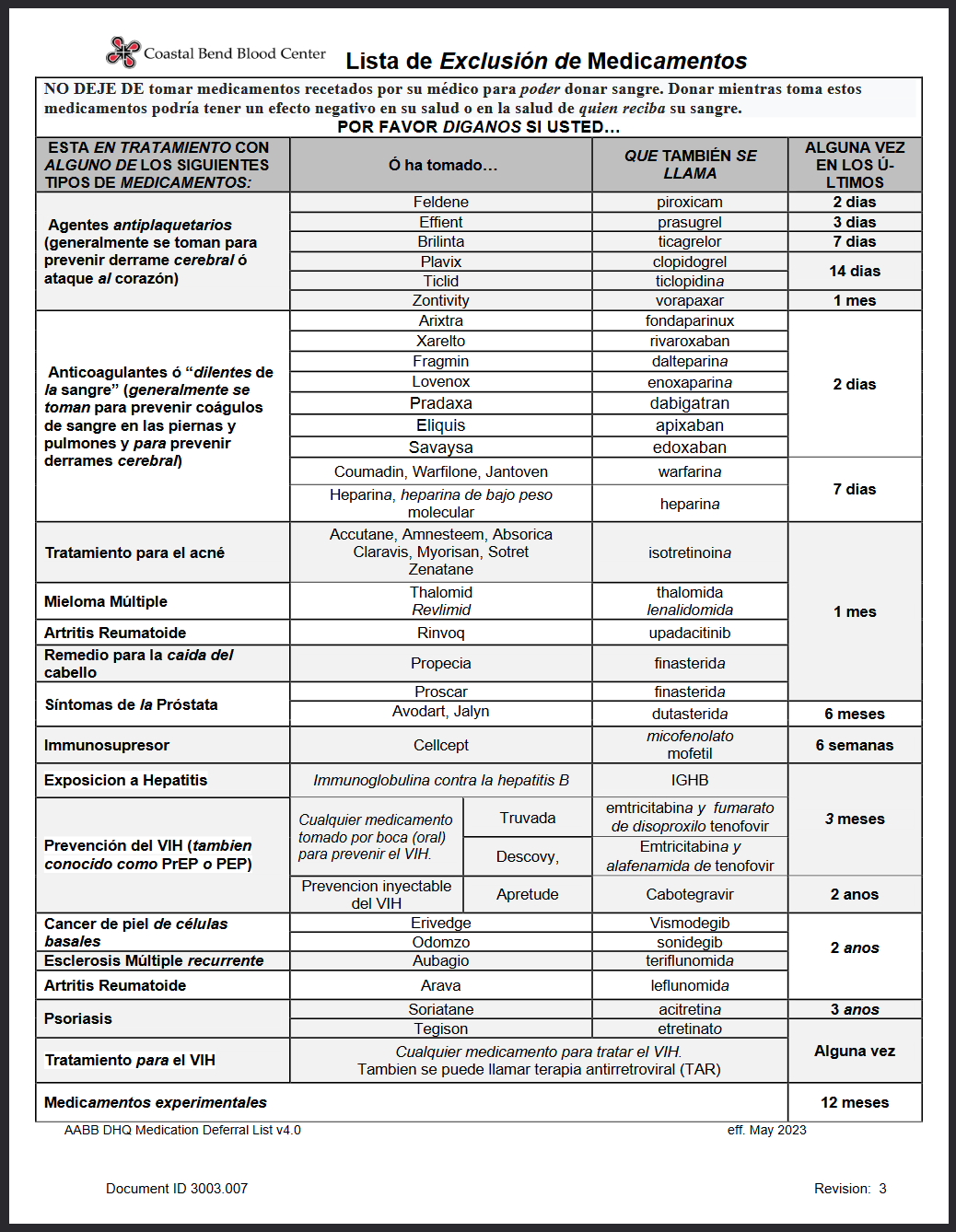
Lista de Medicamentos
NO DEJE DE tomar medicamentos recetados por su médico para donar sangre.
Algunos medicamentos afectan su elegibilidad como donante de sangre, por las siguientes razones:
Los agentes antiplaquetas afectan la función de las plaquetas,por lo que las personas que toman estos medicamentos no deben donar plaquestas durante el tiempo indicado; Es posible que aún pueda donar sangre entera o glóbulos rojos mediante aféresis.
Los anticoagulantes ó “diluyentes de la sangre”se usan para tratar o prevenir coágulos de sangre en las piernas, los pulmones, u otras partes del cuerpo, y para prevenir accidents cerebrovasculares. Estos medicamentos afectan la capacidad de coagulación de la sangre, lo que puede provocar hematomas ó sangrado excesivos cuando se dona. Es posible que aún pueda donar sangre entera o glóbulos rojos mediante aféresis.
La isotretinoina, finasterida, dutasteride acitretina y etretinato pueden causar defectos de nacimiento. La
sangre donada podría contener niveles suficientemente altos como para dañar al feto si se transfunde a una mujer embarazada.
Thalomid (talomida), Revlimid (lenalidomida), Erivedge (Vismodegib), Odomzo (sonidegib), Aubagio (teriflunomida), y Rinvoq (upadacitinib)pueden causar defectos de Nacimiento o la Muerte del feto si se transfunden a una mujer embarazada.
Cellcept (micofenolato mofetilo) y Arava (leflunomida) son immunosupresores que pueden causar defectos
de Nacimiento o la Muerte del feto si se transfunden a una mujer embarazada.
La PrEP o profilaxis previa a la exposición implica tomar una combinación específica de medicamentos orales
(es decir, PrEP antiviral de acción corta) o inyecciones (es decir, PrEP antiviral de acción prolongada) como
método de prevención para las personas que son VIH negativas y con alto riesgo de contraer el VIH infeccion. La FDA ha determinado que los datos disponibles demuestran que el uso de PrEP o PEP puede retrasar la detección del VIH mediante las pruebas de detección actualmente autorizadas para donaciones de sangre, lo que podría generar resultados falsos negativos en personas infectadas. Aunque “Indetectable = Intransmisible” para la transmisión sexual, esto no se aplica a la transmisión por transfusión.
La PEP o profilaxis post-tratamiento de accion corta que se incia lo antes posible después de una exposición
de alto riesgo al VIH para reducir el riesgo de infección. La FDA ha determinado que los datos disponibles demuestran que el uso de PrEP o PEP puede retrasar la detección del VIH mediante las pruebas de detección actualmente autorizadas para donaciones de sangre, lo que podría generar resultados falsos negativos en personas infectadas. Aunque “Indetectable = Intransmisible” para la transmisión sexual, esto no se aplica a la transmisión por transfusión.
ART o terapia antirretroviral es el uso de una combinación de medicamentos contra el VIH (llamado régimen
contra el VIH) para tratar la infección por VIH. La infección por VIH requiere un aplazamiento permanente a
pesar del tratamiento con TAR. Los medicamentos antirretrovirales no eliminant completamente el virus del
cuerpo, y la sangre donada de personas infectadas con el VIH que recibentratamiento antiretroviral aún puede
transmitir el VIH al receptor de una transfusión. Aunque “Indetectable = Intransmisible” para la transmisión
sexual, esto no se aplica a la transmisión por transfusión.
La Inmunoglobulina contra la Hepatitis B (IGHB) es un material inyectable que se utiliza para prevenir la
infección por hepatitis B después de una exposición posible ó conocida a la hepatitis B. La inmunoglobulina contra la hepatitis B no previene la infección por hepatitis B en todos los casos, por lo tanto, las personas que hayan recibido IGHB deben esperar para donar sangre.
Los Medicamentos experimentalessuelen estar asociados con un estudio de investigación, y se desconoce su efecto sobre la seguridad de la sangre transfundida.
Medical Conditions List
(REFER TO QUESTION # 66 ON THE DONATION RECORD)
Please tell us if you have/had any of the following…
Diabetes treated with insulin.
Infectious Illness:
• Fever greater than 100.4°F, past 2 weeks
• Flu-like illness, past 2 weeks
• Infectious illness, past 2 weeks
• Hepatitis E, past 2 weeks
Exposure to Risk:
• Dental procedure, minor surgery (root canal, gum
grafting, tooth extraction, oral surgery or similar
treatment), past 1 week
• Dental procedure, minor treatment (routine checkup
where dentist tools actually come in contact with teeth
and gum, cleaning, fillings, crowns or orthodontic work),
past 1 day
• Acupuncture, not using sterile single-use needles, past
12 months
• Rabies vaccine after exposure, past 12 months
Infectious Disease:
• Osteomyelitis, past 2 years
• Rheumatic Fever, past 2 years
• Tuberculosis (TB), past 2 years
• Human T-lymphotropic Virus (HTLV I/II)
Neurological Disorder:
• History of convulsions, past 3 years
• Repeated episodes of syncope, past 3 years
• Treated with anticonvulsant medication,
past 3 years
Central Nervous System Disease:
• Guillain-Barré Syndrome (GBS)
• Multiple Sclerosis (MS)
• Muscular Dystrophy
• Myasthenia Gravis
• Parkinson’s Disease
Other Conditions:
• Kala Azar (visceral leishmaniasis)
• Brucellosis
• Q fever
• Tick-borne encephalitis vaccines
• Toxoplasmosis
• Toxoids
• Tuberculosis
• Leprosy
LISTA DE CONDICIONES MÉDICAS
(REFIÉRASE A LA PREGUNTA # 66 EN EL REGISTRO DE DONACIÓN)
Algunas condiciones médicas pueden afectar el procesamiento de su donación.
Por favor, díganos si tiene o ha tenido alguna de las siguientes condiciones…
Diabetes tratada con insulina.
Enfermedades Infecciosas:
• Fiebre mayor a 100.4 °F en las ultimas dos semanas
• Gripe en las ultimas dos semanas.
• Enfermedades Infecciosas en las ultimas dos semanas
• Hepatitis E, en las ultimas dos semanas
Riesgo de Exposicion:
• Procedimientos dentales, cirugía menor (endodoncia,
injerto en las encias, extraccion de dientes, cirugía oral o
tratamiento similar) en la ultima semana pasada
• Procedimientos dentales, tratamientos menores
(chequeo de rutina endonde instrumentos estan en
contacto con dientes y encias, limpieza, rellenos,
coronas o trabajo de ortodoncia), durante el pasado dia
• Acupuntura, sin utilizar aguja esteril de uso único en los
ultimos 12 meses
• Vacuna contra la rabia, despues de exposicion, en los
ultimos 12 meses
Enfermedades Infecciosas:
• Osteomielitis en los ultimos 2 años
• Fiebre Reumatica en los ultimos 2 años
• Tuberculosis (TB) en los ultimos 2 años
• Virus Linfotópico T Humano (HTLV I/II)
Desordenes Neurologicos:
• Historial de convulsions en los ultimos 3 años
• Episodios repetidos de síncope en los ultimos 3 años
• Tratamientos con medicamentos anticonvulsantes en los
ultimos 3 años
Enfermedades del Sistema Nervioso Central:
• Síndrome de Guillain-Barré (GBS)
• Esclerosis Multiple
• Distrophia Muscular
• Myasthenia Gravis
• Enfermedad de Parkinson
Otras Condiciones:
• Kala Azar (visceral leishmaniasis)
• Brucellosis
• Fiebre Q
• Vacuna para encefalitis transmitida por garrapatas
• Toxoplasmosis
• Toxoids
• Tuberculosis
• Lepra
Enfermedades Gastrointestinales, Genitourinaria, Hematologicas, Inmunologica, Metabolica, Renales o Enfermedades de el Systema Respiratorio.
• Enfermedad de Addison
• Hepatitis Autoinmune
• Cirrosis Biliar
• Enfermedad Celiaca
• Enfermedad de Chagas
• Cistitis Crónica
• Syndrome de Fatiga Crónica
• Prostatitis Crónica / Endometriosis Crónica
• Enfermedades del Tejido Conectivo
• Enfermedad de Crohn
• Enfermedad de Cushing
• Diverticulitis
• Enfermedad Terminal del Riñon
• Endometriosis
• Varices del Esófago
• Higado Graso
• Fibromialgia
• Glomerulonefritis
• Enfermedad de Grave
• Tiroiditis Hashimoto
• Enfermedad Inflamatoria del Intestino
• Fallo Renal
• Cirrosis del Higado
• Enfermedad Mitocondrial
• Recibiendo Dialysis (peritoneal/hemodialysis)
• Enfermedad Pelvica Inflamatoria
• Ulcera Peptica
• Psoriasis
• Pielonephritis
• Artritis Reumatoide
• Escleroderma
• Lupus Sistemico
• Colitis Ulcerativa
• Syndrome de Vasculitis
• Enfermedad de Wilson
Document ID 3003.010
Revision: 2
YOU MUST READ THIS BEFORE YOU DONATE!
Your accurate and honest responses are critical to the safety of patients who receive blood transfusions.
Each question is necessary to fully evaluate the safety of your donation.
As required by regulations, we are instructing you not to donate blood if you have a risk factor.
If you don’t understand a question, ask the blood center staff for assistance.
YOUR RESPONSES ARE CONFIDENTIAL.
To determine if you are eligible to donate, we will:
Ask about your health and medications you are taking or have taken.
Ask if you have traveled to or lived in other countries.
Ask about your risk for infections that can be transmitted by blood – especially HIV (which is the virus that causes AIDS), and viral hepatitis.
Take your blood pressure, temperature, and pulse.
Take a blood sample to be sure your blood count is acceptable before you donate.
If you are eligible to donate, we will:
Clean your arm with an antiseptic (Tell us if you have any skin allergies).
Use a sterile needle and tubing set to collect your blood.
We NEVER reuse a needle or tubing set.
WHAT HAPPENS AFTER YOUR DONATION
To protect patients, your blood is tested for hepatitis B and C, HIV, syphilis, and other infections. If your blood tests positive, it will not be given to a patient. You will be notified about any positive test result which may affect when you are eligible to donate in the future. There are times when your blood is not tested. If this occurs, you may not receive any notification. The blood center will not release your test results without your written permission unless required by law (e.g., to the Health Department).
DONOR ELIGIBILITY – SPECIFIC INFORMATION
Certain infectious diseases, such as HIV and hepatitis, can be spread through:
Sexual contact
Other activities that increase risk
Blood transfusion
We will ask specific questions about sexual contact and other activities that may increase risk for these infections.
What do we mean by “sexual contact?”
The words “have sexual contact with” and “sex” are used in some of the questions we will ask you. These questions apply to all of the activities below, whether or not medications, condoms or other protection were used to prevent infection or pregnancy:
Vaginal sex (contact between penis and vagina)
Oral sex (mouth or tongue on someone’s vagina, penis, or anus)
Anal sex (contact between penis and anus)
A “new sexual partner” includes the following examples:
Having sex with someone for the first time
OR
Having had sex with someone in a relationship that ended in the past and having sex again with that person in the last 3 months.
HIV/Hepatitis risk factors
HIV and hepatitis are spread mainly by sexual contact with an infected person OR by sharing needles or syringes used by an infected person to inject drugs.
DO NOT DONATE if you:
Have EVER taken any medication to treat HIV infection.
Are taking any medication to prevent HIV infection. These medications may be called: PrEP, PEP, TRUVADA, DESCOVY, APRETUDE or many other names.
FDA-approved antiretroviral drugs are safe and effective in preventing sexual transmission of HIV. However, these antiretroviral drugs do not fully eliminate the virus from the body, and donated blood can potentially still transmit HIV infection to a transfusion recipient.
DO NOTSTOP TAKING ANY PRESCRIBED MEDICATIONS IN ORDER TO DONATE BLOOD, INCLUDING PrEP and PEP MEDICATIONS.
DO NOT DONATE if you:
Have EVER had a positive test for HIV infection.
In the past 3 months:
Have had sexual contact with a new partner and have had anal sex.
Have had sexual contact with more than one partner and have had anal sex.
Have had sexual contact with anyone who has ever had a positive test for HIV infection.
Have received money, drugs, or other payment for sex.
Have used needles to inject drugs, steroids, or anything not prescribed by your doctor.
Have had sexual contact with anyone who has received money, drugs, or other payment for sex, or used needles to inject drugs, steroids, or anything not prescribed by their doctor.
Have had syphilis or gonorrhea or been treated for syphilis or gonorrhea.
In the past 12 months:
Have been in juvenile detention, lockup, jail or prison for 72 hours or more consecutively.
Have EVER had Ebola disease.
DO NOT DONATE if you have these symptoms which can be present before you test positive for HIV:
Fever
Enlarged lymph glands
Sore throat
Rash
Your blood can transmit infections, including HIV, even if you feel well and all your tests are normal. Even the best tests cannot detect the virus for a period of time after you are infected.
DO NOT DONATE:
If you think you may be at risk for HIV or other infections.
If your purpose for donating is to obtain test results for HIV or other infections. Ask us where you can be tested for HIV and other infections.
If your donation might harm the patient who receives your blood.
THANK YOU FOR DONATING BLOOD TODAY!
Coastal bend Blood Center 361-855-4943 or 1-800-299-4943
AABB DHQ v4.0 Blood Donor Educational Material Updated for Ebola
eff. July 2026
Document ID 3003.008
Revision: 4
DEBES LEER ESTO ANTES DE DONAR!
• Sus respuestas precisas y honestas son criticas para laseguridad de los pacientes que reciben transfusiones de sangre. • Cada pregunta es necesaria para evaluar completamente la seguridad de su donación. • Según lo requieren las regulaciones, le pedimos que no done sangre si tiene un factor de riesgo. • Si no entiende una pregunta, pida ayuda al personal del centro de sangre. • SUS RESPUESTAS SON CONFIDENCIALES.
Para determinar si usted es elegible para donar, nosotros:
• Preguntaremos sobre su salud y los medicamentos que está tomando o ha tomado. • Preguntaremos si ha viajado o vivido en otros países. • Preguntaremos sobre su riesgo de infecciones que pueden Transmitirse por la sangre, especialmente el VIH (que es el virus que causa el SIDA) y la hepatitis viral. • Tomaremos su presión sanguinea, temperatura y pulso. • Tomaremos una muestra de sangre para asegurarmos de que su Conteo sanguíneo es aceptable antes de que usted done.
Si usted es elegible para donar, nosotros:
• Limpiaremos su brazo con un antiséptico (Diganos si tiene alguna alergia de la piel). • Usaremos una aguja y un set de tubos estériles para colectar su sangre.
NUNCA reusamos una aguja o set de tubos.
QUÉ SUCEDE DESPUÉS DE SU DONACIÓN
Para proteger a los pacientes, su sangre será analizada para detectar hepatitis B y C, VIH, sífilis y otras infecciones. Si su sangre resulta positiva, no se le dará a ningún paciente. Se le notificará sobre cualquier resultado positivo que pueda afectar cuando usted es elegible para donar en el futuro. Hay ocasiones en las que no se analiza su sangre. Si esto ocurre, puede que no reciba ninguna notificación. El centro de sangre no divulgará los resultados de sus pruebas sin su permiso por escrito, a menos que sea requerido por ley (por ejemplo, al Departamento de Salud).
ELEGIBILIDAD DEL DONANTE: INFORMACIÓN ESPECÍFICA
Ciertas enfermedades infecciosas, como el VIH y la hepatitis, se pueden transmitir a través de: • Contacto sexual • Otras actividades que aumentan el riesgo • Transfusión de sangre Le haremos preguntas específicas sobre contacto sexual y otras actividades que pueden aumentar el riesgo de contraer estas infecciones.
Qué queremos decir con “contacto sexual”?
Las palabras “ha tenido contacto sexual con” y “sexo” se utilizan en algunas de las preguntas que le haremos. Estas preguntas se aplican a todas las actividades descritas a continuación, se hayan usado o no medicamentos, condones u otra protección para prevenir infecciones o embarazos:
• Sexo vaginal (contacto entre el pene y la vagina) • Sexo oral (boca o lengua en la vagina, el pene o el ano de una persona) • Sexo anal (contacto entre el pene y el ano)
Una “pareja sexual nueva” incluye los siguientes ejemplos:
• Tener sexo con alguien por primera vez O • Haber tenido sexo con alguien en una relación que terminó en el pasado y haber tenido sexo nuevamente con esa persona en los últimos 3 meses.
Factores de riesgo de VIH/hepatitis
El VIH y la hepatitis se transmiten mayormente por contacto sexual con una persona infectada O por compartir agujas o jeringuillas usadas por una persona infectada para inyectarse drogas.
NO DONE si usted:
• ALGUNA VEZ ha tomando algún medicamento para tratar la infección con el VIH. • Está tomando algún medicamento para prevenir la infeccióncon el VIH. Estos medicamentos se pueden llamar: PrEP, PEP,TRUVADA, DESCOVY, APRETUDE o muchos otros nombres.
Los medicamentos antirretrovirales aprobados por el FDA son seguros y eficaces para prevenir la transmisión sexual del VIH. Sin embargo, estos medicamentos antirretrovirales no eliminan completamente el virus del cuerpo completamente, y la sangre donada tiene el potencial de transmitir la infección con VIH a quien recibe una transfusión.
NO DEJE DE TOMAR NINGÚN MEDICAMENTO RECETADO PARA PODER DONAR SANGRE, INCLUYENDO LOS MEDICAMENTOS DE PrEP y PEP..
NO DONE si usted:
• ALGUNA VEZ ha tenido una prueba positiva para la infección con el VIH. • En los últimos 3 meses: o Ha tenido contacto sexual con una pareja nueva y ha tenido sexo anal. o Ha tenido contacto sexual con más de una pareja y ha tenido sexo anal. o Ha tenido contacto sexual con alguien que alguna vez haya tenido una prueba positiva para la infección con el VIH. o Ha recibido dinero, drogas u otro pago por sexo. o Ha usado agujas para inyectarse drogas, esteroides o algo no recetado por su médico. o Ha tenido contacto sexual con alguien que haya recibido dinero, drogas u otro pago por sexo, o que haya usado agujas para inyectarse drogas, esteroides o algo no recetado por su médico. o Ha tenido sífilis o gonorrea o ha recibido tratamiento para sífilis o gonorrea.
En los últimos 12 meses:
o Ha estado en un centro de detención juvenil, detentciún, cárcel o prisión por 72 horas o más consecutivas. • ALGUNA VEZ ha tenido la enfermedad del Ébola.
NO DONE si usted tiene estos síntomas que pueden estar presentes antes de dar positivo en la prueba del VIH:
• Fiebre • Ganglios linfáticas agrandadas • Dolor de garganta • Salpullido Su sangre puede transmitir infecciones, incluyendo el VIH, aunque usted se sienta bien y todas sus pruebas sean normales. Incluso las mejores pruebas no pueden detectar el virus durante un período de tiempo después de que se haya infectado.
NO DONE:
• Si cree que puede estar en riesgo de contraer el VIH u otras infecciones. • Si su propósito para donar es obtener resultados para las pruebas de VIH u otras infecciones. Pregúntanos dónde se puede hacer las pruebas del VIH y otras infecciones. • Si su donación puede causarle daño al paciente que reciba su sangre. GRACIAS POR DONAR SANGRE HOY!
AABB DHQ v4.0 Blood Donor Educational Material Updated for Ebola
eff. July 2026
Document ID 3003.008
Revision: 4
We use cookies to ensure that we give you the best experience on our website. See our cookie policy.